
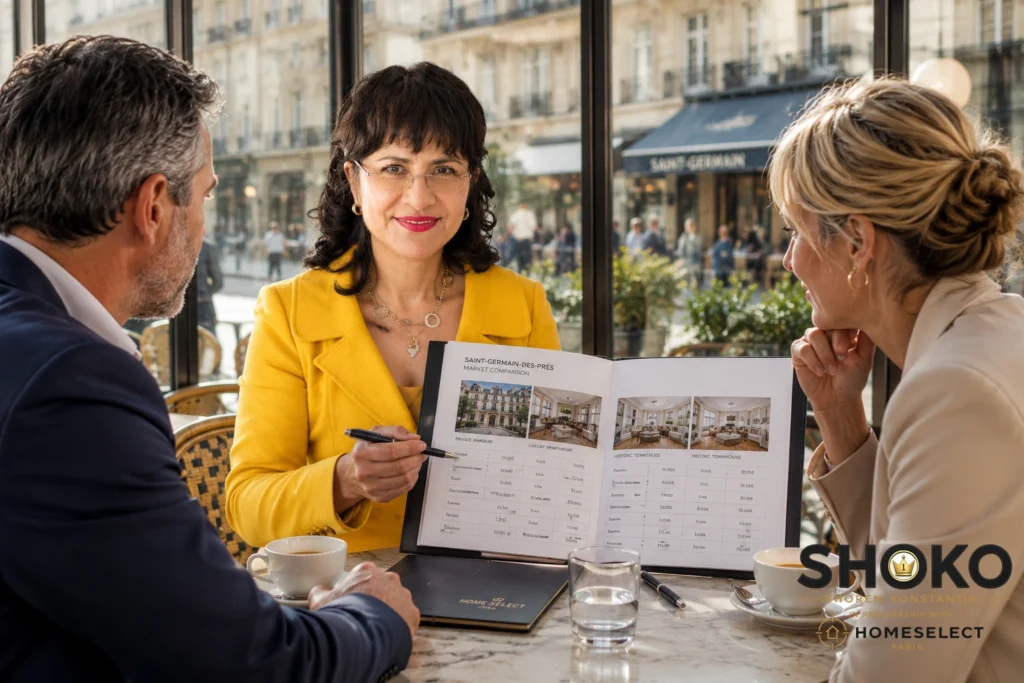
Paris vs Berlin: How International Buyers Experience Property Culture Differently
Visit an apartment in Prenzlauer Berg on a Tuesday and one in the 6th arrondissement the following week, and you will notice something before you notice the prices: the two cities do not think about property the same way. In Berlin, the agent talks about potential — what the district is becoming, what the building could be worth once the area finishes gentrifying. In Paris, the agent talks about permanence — what the building has always been, which families have held apartments there, and why nothing about the street will change. Neither pitch is wrong. But international buyers who assume the two capitals are interchangeable European markets tend to misprice both.
A City of Tenants and a City of Owners
Berlin remains, culturally and statistically, a city of renters. The large majority of Berliners rent their homes, and the city’s politics, regulation, and even its social identity are organized around tenancy. Ownership is the exception, and it often carries a faint whiff of speculation. Paris sits at the other end of the spectrum. The Parisian copropriété is a multigenerational institution — apartments are held for decades, passed within families, and treated as patrimoine rather than as a position to be traded.
The numbers behind the culture are striking: home ownership in Berlin hovers in the teens as a percentage of households, among the lowest of any major city in the developed world, while in Paris roughly a third of residents own their homes and a far larger share of the housing stock is owner-held as a secondary or family asset. A Berlin apartment building is typically a single investment owned by a company or fund; a Paris building is a copropriété of fifteen private owners with a syndic, an annual assembly, and opinions.
In practice, this cultural difference shapes everything a buyer touches. In Berlin, much of the sale inventory consists of tenanted apartments where the sitting tenant enjoys formidable legal protection, meaning you may buy a home you cannot occupy for years. In Paris, the overwhelming majority of transactions are vacant possession, and the question is not whether you can live in what you buy but whether you can win it against competing owner-occupiers.
What the Numbers Actually Say
On price, the gap is wide and persistent. Official French government transaction data (DVF) puts Paris apartments at roughly €9,700 to €10,000 per square meter citywide in mid-2026, rising above €15,000 in the 6th arrondissement. Berlin’s citywide averages sit far lower — commonly around half the Paris level — with even prime districts like Mitte or Charlottenburg rarely approaching central Paris pricing.
But the more revealing number is volatility. Berlin roughly doubled in the 2010s, then corrected visibly when interest rates rose in 2022 and 2023. Paris, over the same rate shock, dipped modestly and has since returned to gentle growth of one to three percent annually. Buyers comparing the two are not comparing cheap versus expensive; they are comparing a young, cyclical market against one of the most inertial property markets in the world.
Transaction depth tells the same story from another angle. Paris records tens of thousands of apartment sales in a normal year — a liquid, information-rich market where comparable prices are knowable street by street. Berlin’s ownership market is thinner and lumpier, dominated in some years by portfolio trades between institutions rather than by households, which makes any single asking price harder to anchor against real evidence.
Two Very Different Buying Processes
Germany and France both use a public legal officer to close transactions, but the resemblance ends quickly. In Germany, the Notar reads the entire contract aloud at signing, there is no statutory cooling-off period for standard purchases, and transfer tax in Berlin adds around six percent before agent fees. In France, the compromis de vente comes with a ten-day withdrawal right for the buyer, protective suspensive conditions are standard, and notaire fees run over eight percent following the April 2025 departmental tax increase.
Buyers who have studied how Paris property hunting differs from London, New York, and Dubai will recognize the pattern: France front-loads friction and protection onto the buyer’s side, while Germany assumes a professionalized buyer who needs neither. Many international buyers discover that the French system, for all its paperwork, is structurally kinder to them.
Regulation as Market Weather
Berlin’s recent history includes a rent cap struck down by Germany’s constitutional court and a citywide referendum in which a majority voted to expropriate large corporate landlords. None of it was fully implemented, but the direction of political travel is part of the price. Paris has its own rent controls, yet the ownership market itself — who may buy, what they may own, how it may be resold — has remained essentially untouched for generations, regardless of which party governs.
Neither city is deregulated — Paris operates its own encadrement des loyers capping rents, and French tenancy law is famously protective. The difference is where the uncertainty sits. In Paris the rules are old, tested, and priced in; in Berlin the rules themselves remain a live political question, revisited with each election cycle.
This is one reason what sets Paris apart from every other European capital property market is less about glamour than about predictability. An international buyer in Berlin is making a judgment about German housing politics. A buyer in Paris is mostly making a judgment about a specific building on a specific street.
Supply Is the Deciding Difference
Here is the observation worth carrying out of this comparison: Berlin prices what it can still build, while Paris prices what can never be built again. Berlin has land — former airfields, industrial belts, low-rise blocks that can densify. Every price rise eventually summons cranes. Paris intra-muros is physically finished. The Haussmann city was completed in the nineteenth century, height limits protect the skyline, and the supply of classic apartments inside the Périphérique is a fixed number that only erodes as buildings convert to offices or hotels.
For a buyer, this changes what appreciation means. Berlin appreciation is a bet that demand outruns construction. Paris appreciation is closer to arithmetic: stable demand meeting a supply curve that cannot respond at all.
What This Means for an International Buyer
If your goal is yield and you are comfortable with regulatory noise, Berlin’s lower entry prices have genuine logic. If your goal is capital preservation in an asset your grandchildren will recognize, Paris is playing a different sport. Financing also tilts the comparison: qualified non-resident buyers can access French mortgage structures that are unusually favorable by international standards, and understanding how mortgage financing in France actually works for international buyers often changes the budget conversation entirely.
One pattern worth understanding: buyers who visit both cities rarely stay undecided for long. The two markets answer different questions, and most people know which question they are really asking.
If you are weighing Paris against another capital and want an independent view of what your budget genuinely commands here, Contact SHOKO for a private consultation.
Recommended Reads
Paris vs London — Where International Buyers Are Putting Their Money Now — gtamarket.ca
How Swiss Buyers Compare Paris Real Estate to Geneva and Zurich — gtamarket.ca
The French Property Buying Process Explained — buyeragentfrance.com
Cost of Living in Paris 2026 — What Expats Actually Spend — homefrance.eu