
What Sets Paris Apart From Every Other European Capital Property Market
Every major European capital has its advocates among international property buyers. London, Berlin, Amsterdam, Madrid, and Vienna each attract significant foreign investment. But Paris occupies a category of its own — and the reasons for that are not primarily emotional. They are structural, legal, architectural, and demographic in ways that no other European capital fully replicates.
Understanding what makes Paris genuinely different — not just appealing, but structurally distinct — is essential for any international buyer evaluating where to allocate capital in Europe.
Architectural Coherence — The Haussmann Framework
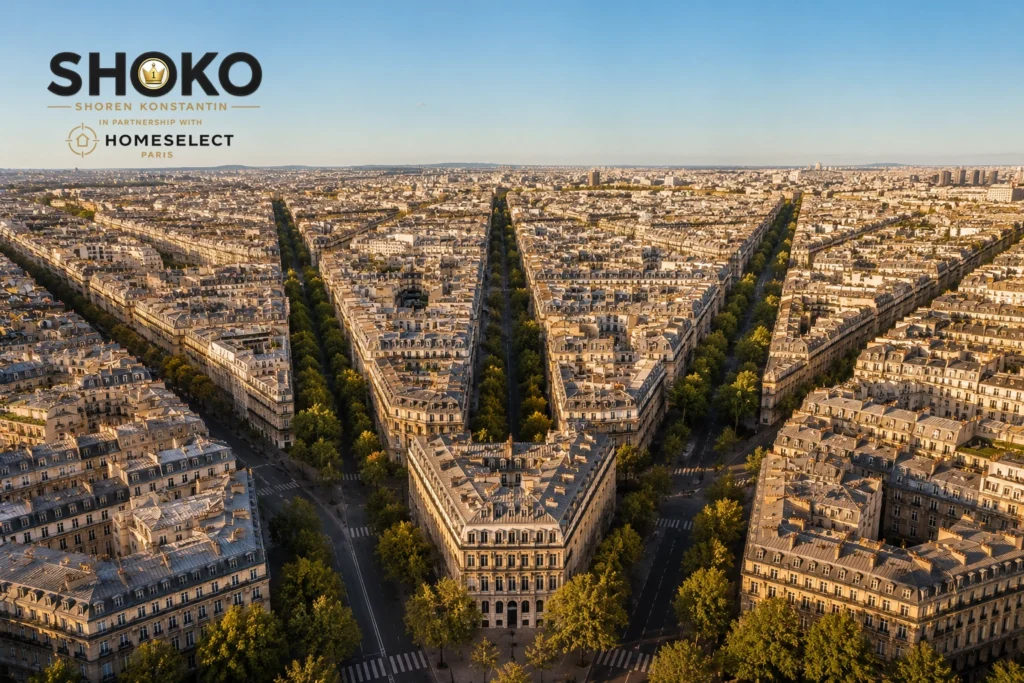
No other major European capital has architectural coherence comparable to Paris. Baron Haussmann’s transformation of the city between 1853 and 1870 created a unified visual language — cream limestone facades, uniform cornice heights, wrought iron balconies, and a consistent street grid — that covers the vast majority of the city’s most desirable residential areas.
This is not merely aesthetic. Architectural uniformity means that properties in the premium arrondissements age in a predictable and consistent way. There are no jarring contrasts between neighbouring buildings. The street value of each property is supported by the quality of everything around it. This structural visual consistency is something London, Berlin, and Amsterdam — all of which contain eclectic mixes of building periods and styles — simply cannot match.
The Notaire System — Legal Certainty That Is Embedded in Every Transaction
France’s notaire system is unique in Europe. Every property transaction in France — without exception — passes through a state-appointed notaire whose function is not to represent either party, but to ensure the transaction conforms fully to French civil law. Ownership is registered by the French state itself, making title disputes of the kind that occur in common law systems virtually non-existent.
For international buyers, this creates a level of legal certainty that markets operating under looser transactional frameworks cannot offer. You know exactly what you are buying, what encumbrances exist, and what your legal position is — before you sign anything. This is one of the primary reasons sophisticated international investors treat Paris as a low-risk acquisition environment.
No Foreign Buyer Surcharges — Unlike London
London — long considered the primary alternative to Paris for international real estate capital — introduced a 2% stamp duty surcharge for non-UK residents in 2021, on top of already significant existing charges. This added meaningful cost to foreign acquisition and sent a clear signal about the direction of UK policy toward international buyers.
France has introduced no equivalent measure. Foreign buyers purchase on identical legal and fiscal terms to French citizens. There are no ownership caps, no residency requirements, and no retrospective charges. The French government’s consistent posture has been to welcome international capital, and this posture has remained stable across successive governments of different political directions.
The Copropriété System — Collective Ownership With Built-In Accountability
Most Paris apartments exist within a copropriété — a co-ownership structure in which all apartment owners jointly own the building’s common areas and share responsibility for maintenance and charges. This system, governed by strict French law, means that every building has a mandated annual general meeting, published accounts, and a reserve fund for major works.
For buyers, this transparency is a significant advantage. Before purchasing, you receive the full history of the building’s charges, planned works, and financial reserves. There are no hidden surprises about the building’s condition or future costs — everything is documented, legally required to be disclosed, and independently verifiable.
The International Buyer Pool — Depth and Diversity No Other City Matches
The Paris luxury property market draws buyers from every continent — North American, Gulf, European, Asian, African, and Latin American buyers are all consistently active. This geographic diversity of demand is itself a structural asset. It means that the market’s performance is never dependent on the economic conditions of a single region or buyer nationality.
When one buyer group slows — as UK buyers did post-Brexit, as Russian buyers did after 2022 — others continue and often accelerate. This diversity insulates the Paris market from the kind of nationality-specific demand shocks that more concentrated markets are vulnerable to. No other European capital has buyer demand this internationally distributed.
What This Means for Your Acquisition Decision
For an international buyer evaluating European real estate as a long-term asset, Paris offers a combination that is not replicated elsewhere: architectural permanence, legal certainty, policy stability, transaction transparency, and a buyer pool diverse enough to support demand through multiple economic cycles.
These are not marketing claims. They are observable structural facts about how the Paris market works — and they explain why Paris has consistently held its premium over every other European capital for more than a century.
If you are an international buyer looking to acquire in Paris with full representation and expert guidance, Contact SHOKO. We work exclusively for buyers in the premium Paris arrondissements.
Recommended Reads
How Middle Eastern Buyers Research Paris Real Estate Before Making First Contact — gtamarket.ca
Why Paris Real Estate Appeals to Buyers Who Value Political Stability — gtamarket.ca
What a Paris Buyer Agent Actually Does on Your Behalf — buyeragentfrance.com
The Practical Expat Guide to Daily Life in Paris — homefrance.eu