
Why International Buyers Value Paris Architectural Heritage Above All Other European Cities
Ask a hundred international buyers why they chose Paris over Rome, Vienna, or London, and a surprising number will answer with a single word: coherence. Paris is not simply old. Many European capitals are old. What sets Paris apart is that its 19th-century transformation under Baron Haussmann produced a citywide architectural language that has been protected, maintained, and reinforced for more than 150 years, rather than diluted by piecemeal redevelopment.
For buyers weighing where to place significant capital in European real estate, that coherence is not an aesthetic footnote. It is a structural feature of the asset itself.
A City Built as a Single Idea
Most historic European capitals show visible seams between eras — a medieval quarter here, a brutalist block there, a glass tower breaking the skyline of an otherwise 18th-century street. Paris, by contrast, reads as a single sustained composition across most of its central arrondissements. Uniform cream limestone façades, matching zinc roofs at a consistent pitch, wrought-iron balconies at the second and fifth floors, and a strict height ceiling of roughly six or seven storeys were not accidents of taste. They were the result of building codes imposed in the 1850s and 1860s and defended by preservation authorities ever since.
International buyers researching historic Parisian hôtels particuliers quickly discover that this protection extends well beyond the grand Haussmann boulevards into the private mansions and courtyard buildings tucked behind them — an entire second layer of heritage that rarely appears in a first-pass tour of the city.
Why This Matters for Long-Term Value
Architectural coherence functions as a form of built-in downside protection. A buyer in a protected Haussmann building is not exposed to the risk that an incompatible high-rise or a discount retail development changes the character of the street five years after purchase. Paris’s protected sightlines, façade regulations, and historic district classifications (secteurs sauvegardés) make that kind of disruption structurally difficult, which is precisely why prime arrondissements have shown such durable pricing over multi-decade horizons.
Buyers drawn to pre-war Haussmann apartments are frequently making this calculation instinctively, even before they articulate it in investment terms: they are buying into a streetscape that cannot easily be degraded by what gets built next door.
The Details That Signal Genuine Heritage
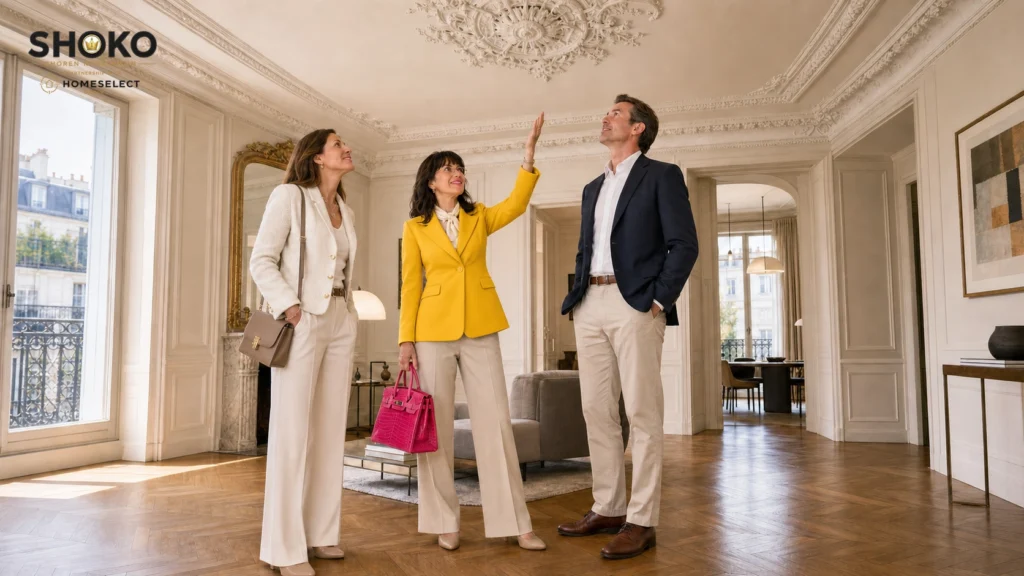
Not every apartment behind a beautiful façade delivers on the promise of the building. Serious buyers learn to look past the street-level impression and check for the interior markers that separate an authentic Haussmann apartment from a later reconfiguration: original herringbone parquet, carved stone or plaster ceiling moldings, marble fireplaces retained rather than removed, tall single-pane windows with their original proportions, and ceiling heights that clear 3 meters on the principal floors (the prized étage noble).
These features are not decorative flourishes. They are the physical evidence that a building’s character has survived intact, and they correlate directly with resale premiums when the time comes to sell.
Financing the Purchase of a Protected Heritage Property
Buying into protected heritage does add a layer of complexity that first-time international buyers do not always anticipate — renovation permissions inside classified buildings can be more restrictive, and lenders sometimes want additional documentation on a building’s protected status before approving a mortgage. This is one of several areas where French mortgage financing for North American buyers benefits from being structured with a lender who has direct experience with heritage properties, rather than treated as a standard residential file.
A Different Kind of Asset Class
For international buyers who have already owned property in cities with less architectural continuity, Paris tends to represent a category shift rather than simply another market. The apartment is not just a home or an investment; it is a small stake in a citywide heritage system that has been actively defended for a century and a half — and that defense is, in itself, one of the strongest arguments for long-term capital preservation that the Paris market offers.
How Paris Compares to Other European Capitals
London offers extraordinary architecture in pockets — Mayfair, Belgravia, parts of Kensington — but those pockets sit inside a much larger city where modern towers, Victorian terraces, and postwar rebuilding coexist without a unifying visual code. Rome has arguably deeper history, yet much of its historic core suffers from decades of deferred maintenance and inconsistent restoration standards outside a handful of prestige addresses. Vienna comes closer to Paris in its imperial-era coherence, but its central real estate market is a fraction of the size and liquidity of Paris, which matters to buyers who eventually want to sell.
What Paris offers that none of these cities quite matches is scale combined with consistency: dozens of contiguous streets across several arrondissements where the architectural standard rarely dips, supported by one of the deepest and most liquid luxury property markets in continental Europe. That combination — heritage plus liquidity — is unusual, and it is a large part of why international buyers researching multiple cities so often land on Paris.
The Regulatory Backbone Behind the Beauty
It is worth understanding, at least at a high level, what actually protects this coherence, because it explains why the risk of degradation is genuinely low rather than simply a matter of current fashion. The Plan Local d’Urbanisme sets strict height and façade rules across central Paris. Bâtiments de France architects must approve exterior modifications to buildings within view of classified monuments, which in practice covers enormous stretches of the city center. Secteurs sauvegardés — protected sector designations — layer additional interior and exterior restrictions onto buildings of particular historical significance.
None of this is unique to one building or one street. It is a citywide regulatory architecture that has been reinforced, not relaxed, across successive French governments of different political colors — which is itself a signal of how deeply embedded the commitment to heritage preservation is in French civic life, independent of any single administration’s priorities.
What This Means for a Buyer Evaluating Two Similar Apartments
In practice, this heritage system changes how a knowledgeable buyer compares two apartments that might look similar in a listing. An apartment on a protected Haussmann boulevard with original moldings, herringbone parquet, and a classified façade carries a different long-term risk profile than a similarly priced apartment in a less protected pocket of the city, even if the second apartment has been more recently renovated and looks more polished in photographs. The renovation can always be redone. The protected status, the streetscape, and the building’s place within the city’s heritage framework cannot be recreated once lost — which is exactly why buyers who understand this distinction tend to prioritize it over surface-level finish quality when comparing options.
Working With Someone Who Understands the Difference
Because heritage status varies building by building, and even floor by floor within the same building, this is not a market where a generic property search delivers reliable results. A buyer’s agent who can distinguish a genuinely protected étage noble apartment from a later, less distinguished renovation — and who understands how that distinction affects both financing and long-term value — is essential to making a confident decision in this segment of the market.
Recommended Reads
Why International Families Choose Specific Paris Arrondissements — gtamarket.ca
What Canadians Find Most Surprising About French Residential Buildings — gtamarket.ca
How the Right Renovation Transforms a Paris Haussmann Apartment Into a Trophy Property — 1empress.com
How to Choose Between the 6th, 7th and 8th Arrondissements When Buying in Paris — buyeragentfrance.com