
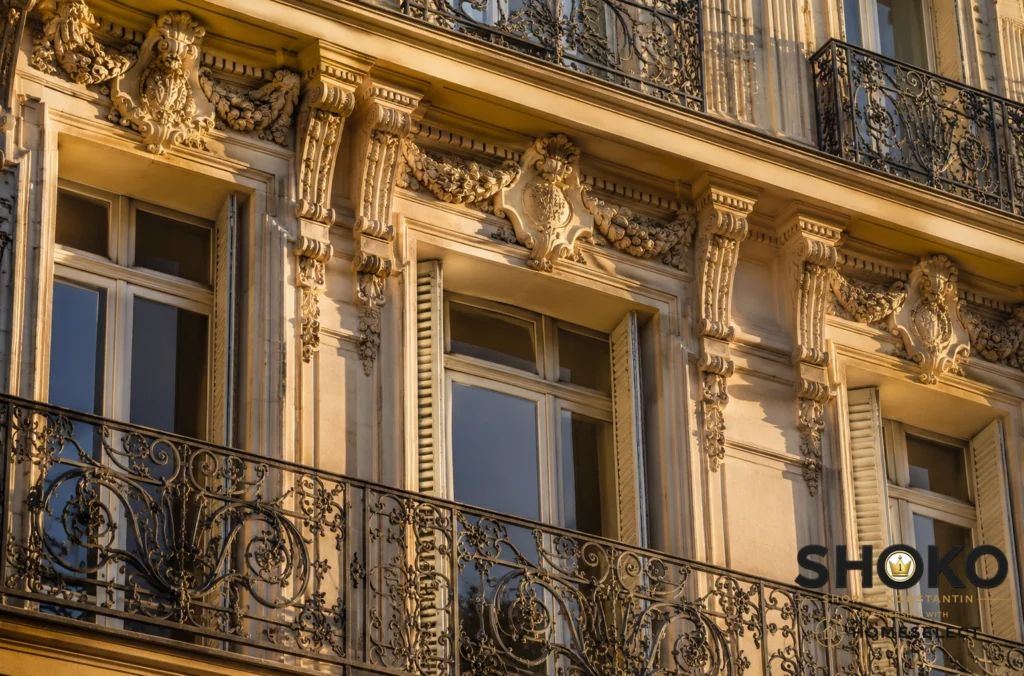
Why Paris Luxury Buyers Are Increasingly Targeting Pre-War Haussmann Apartments
There has always been a consensus in the Paris premium market that Haussmann is good. What has shifted in recent years is the emergence of a more refined view within that consensus — one that distinguishes not just between Haussmann and modern construction, but between different generations and conditions of Haussmann stock. And increasingly, the most experienced buyers are converging on a specific conclusion: the pre-war original is pulling away from everything else.
This is not nostalgia. It is a reading of the market that is supported by transaction data, by the behaviour of the most sophisticated international buyers, and by a structural logic that becomes clearer the more carefully you look at it.
What “Pre-War” Actually Means in the Paris Context
In most property markets, pre-war simply means old. In Paris, it carries a specific meaning that relates directly to construction quality, material integrity, and the irreproducibility of what was built.
The Haussmann transformation of Paris — which ran from the 1850s through to roughly 1914, with a final significant wave in the 1920s — produced buildings constructed from oolitic limestone quarried from the Paris basin. This material has a structural density and a resistance to deterioration that no modern substitute replicates. The load-bearing stone walls of a genuine pre-war Haussmann building are not a heritage feature. They are a construction standard that was abandoned when concrete frame construction became economically dominant after the Second World War.
The distinction matters because it directly affects what you are buying. A pre-war Haussmann apartment sits inside walls that have already demonstrated their integrity across a century of Parisian weather, vibration, and use. Buyers who want to understand why so many international buyers misread the age of Paris buildings will find that the gap between perception and reality is wider than most expect.
The Ceiling Height Question
One of the most immediately legible differences between pre-war and post-war Haussmann stock is ceiling height. The pre-war buildings in the premium arrondissements consistently deliver ceiling heights of 3.2 metres and above on the principal floors — and in the finest buildings, 3.5 metres or higher is not unusual.
These heights are not decorative. They determine the quality of light in an apartment, the sense of proportion in a room, and the feeling of space that no amount of open-plan design can replicate in a lower-ceilinged building. They also carry a direct market premium: apartments with genuine pre-war ceiling heights command meaningfully higher prices per square metre than comparable spaces with lower ceilings, and that premium has been widening rather than narrowing as buyers become more discerning.
Original Parquet, Mouldings, and the Authenticity Premium
The pre-war Haussmann apartment that has not been comprehensively renovated — that retains its original herringbone parquet, its ceiling mouldings, its marble fireplaces, and its original door and window proportions — is increasingly understood by experienced buyers as a rare and valuable thing rather than a property in need of updating.
This represents a genuine shift in market understanding. A decade ago, an unrenovated pre-war apartment was frequently discounted — the assumption was that modernisation was needed and that the cost should be reflected in the price. Today, the more sophisticated reading is the opposite: the original elements are irreplaceable, and a sympathetic renovation that preserves them while updating the kitchen and bathrooms is worth far more than a comprehensive modernisation that stripped them out in favour of a contemporary finish.
The buyers who understood this shift early have done very well. The buyers arriving now are paying to learn a lesson that the market has already absorbed.
Why Modern Renovations Are Being Discounted
The corollary of the authenticity premium is a growing discount applied to pre-war apartments that have been comprehensively renovated in a style that erased the original character. Dropped ceilings to accommodate climate control systems, replacement of original parquet with large-format tile, removal of mouldings for a clean contemporary look — these interventions, which were fashionable among a certain class of renovation in the 2000s and 2010s, are now understood by experienced buyers to have reduced rather than enhanced the long-term value of these apartments.
This is not universal. A well-executed renovation that preserved the key original elements while achieving a high standard of contemporary finish is still valued highly. But the market is now sophisticated enough to distinguish between the two, and the pricing reflects that distinction.
The Supply Constraint That Drives the Premium
The most fundamental reason for the growing premium on genuine pre-war Haussmann stock is the one that applies to all premium Paris real estate: you cannot make more of it. The planning restrictions that prevent demolition or significant alteration of pre-war buildings in the premium arrondissements are absolute. The limestone that was quarried from the Paris basin to build these structures is no longer extracted at scale. The craftsmen who executed the carved details on the facades were working in a tradition that has no living equivalent.
Every year, the pre-war stock becomes marginally scarcer as some buildings are inevitably converted, altered, or damaged beyond recovery. The demand from international buyers who understand what they are looking at is not declining. This is precisely why Paris luxury apartments have maintained their value through every economic cycle in a way that no other major city has consistently replicated.
What This Means for Buyers Entering the Market Now
For international buyers approaching Paris in 2026, the practical implication of this trend is clear: the specification matters as much as the address. Two apartments in the same arrondissement on the same street can represent fundamentally different propositions depending on whether one is a pre-war original with intact character elements and one is a post-war building or a comprehensively renovated pre-war building that has lost its defining characteristics.
Identifying the difference requires the kind of building-by-building knowledge that takes years to develop, and that a buyer arriving from abroad for a series of viewings simply cannot acquire on a timeline that matches how quickly good properties move. This is precisely where an experienced buyer’s agent changes the outcome — not by opening doors that are otherwise closed, but by knowing, before the viewing, which doors are worth opening.
If you are looking at Paris luxury property and want to understand the difference between what the market offers and what you are actually buying, a direct conversation is the most efficient starting point. Contact SHOKO to begin.
Recommended Reads
Why Americans Often Misjudge Older Paris Buildings — gtamarket.ca
How Paris Luxury Apartments Hold Value Through Economic Cycles — gtamarket.ca
Buying Property in Paris 7th, 8th, 16th — Why Buyer Representation Changes Everything — buyeragentfrance.com
Living in Paris as an Expat — Choosing Between the 7th, 8th and 16th Arrondissements — homefrance.eu