
Why Canadians Compare Paris Lifestyle More to Montreal Than Toronto
There is something that happens to Canadian buyers the first time they spend a serious week in Paris — not as tourists, but as people genuinely considering whether they could live there. They stop comparing Paris to Toronto. Almost without noticing, they start comparing it to Montreal.
This shift is not accidental. It reflects something real about how Paris is experienced by Canadians, and why buyers from Quebec and anglophone Canada alike often find the city more familiar, more habitable, and more emotionally legible than they expected. Understanding why this happens tells you a great deal about what kind of city Paris actually is — and why Canadian buyers tend to adapt to it faster than almost any other North American nationality.
The Language Layer
The most obvious factor is language, but it runs deeper than simple comprehension. Montreal is the only major North American city where French is not a curiosity but a default — where public life, signage, service, humour, and social rhythm are organised around the French language. Canadians who grew up in Quebec carry that fluency naturally. But even anglophone Canadians who grew up in Ontario, British Columbia, or Alberta have typically had years of French immersion schooling, mandatory French on every product label, and a cultural familiarity with francophone institutions that Americans simply do not have.
In Paris, this creates a different kind of arrival experience. The language is not a wall. It is a familiar texture, even for those who speak it imperfectly. Walking into a boulangerie, reading a lease, understanding a notaire’s explanation — none of these feel as alien to a Canadian as they might to a buyer arriving from Los Angeles or Sydney. Montreal has been quietly preparing Canadians for Paris for decades.
The Urban Scale
Toronto has spent the last twenty years becoming a vertical city. The condominium tower is now its dominant residential typology — glass, steel, and concrete rising above transit corridors and former industrial land. It is a city that has reorganised itself around density, but a particular kind of density: upward rather than outward, transactional rather than neighbourly.
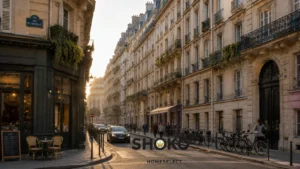
Paris is dense in an entirely different way. It is a horizontal city, rarely exceeding seven or eight storeys, organised around the street rather than the tower. Neighbourhood life happens at ground level — at the market, the café, the fromagerie, the pharmacy. There is a human scale to Paris that Toronto has largely moved away from.
Montreal still has it. The Plateau, Outremont, Westmount, Rosemont — these are neighbourhoods built at a scale that rewards walking, that keep retail and residential life intertwined, that feel like places rather than developments. Canadian buyers who love Montreal for this quality find it immediately recognisable in Paris. The proportions feel right. The streets feel inhabitable.
The Architectural Register
There is also the question of what the buildings look like. Toronto’s residential architecture spans everything from Victorian semi-detached houses to glass-curtain towers, with very little visual coherence at the street level. It is a city of architectural layers deposited without a unifying logic.
Montreal has Haussmann’s spiritual cousin in its greystone walk-ups and its iron staircases — buildings constructed between 1880 and 1930 that share with Parisian architecture a commitment to stone, to proportion, and to the idea that a residential building should contribute to the street rather than merely occupy a lot. When Canadian buyers stand in front of a Haussmann building in the 7th or the 16th and feel something like recognition, part of what they are feeling is Montreal.
This matters practically. Buyers who are psychologically comfortable with older buildings — who understand that thick stone walls mean quieter apartments, that high ceilings mean better light, that an absence of amenities like a gym or a concierge desk does not mean an absence of quality — adapt to the Paris market more quickly. They do not spend weeks trying to reconcile European residential standards with North American condominium expectations. They arrive already calibrated.
The Pace of Life
Toronto operates at a pace that has accelerated noticeably over the past decade. It is a city of long commutes, competitive professional culture, and a social life increasingly organised around efficiency. Spontaneity has become harder. The city rewards productivity.
Montreal has always pushed back against this. Its café culture, its long lunches, its festivals, its unapologetic commitment to pleasure as a civic value — these are not accidents. They reflect a particular Quebec worldview that has more in common with French attitudes toward time and leisure than with the Anglo-North American Protestant work ethic.
Canadian buyers who love Montreal for this quality — who value a city that takes its meals seriously, that does not treat sitting at a café for two hours as wasted time, that separates work from life with genuine intention — find Paris not just acceptable but deeply attractive. The pace is familiar. The priorities feel aligned.
What This Means for the Purchase Decision
Canadian buyers, in practice, tend to move through the Paris acquisition process with less cultural friction than many other North American nationalities. They ask fewer questions about why things work the way they do. They are less likely to resist the notarial system, less likely to be frustrated by the pace of the transaction, less likely to arrive expecting the purchase process to resemble what they know from home.
They also tend to be decisive. Having already done the internal work of comparing Paris to something they know and love — and found Paris to compare favourably — they arrive at viewings with a clearer sense of what they are looking for and a greater readiness to commit.
For buyers still in the consideration phase, the honest question is not whether Paris is better than Toronto or worse than Montreal. It is whether the kind of life Paris offers — walkable, cultured, linguistically rich, architecturally coherent, unhurried — is the kind of life you have been quietly wanting. For most Canadians who spend real time there, the answer tends to arrive before they expected it.
If you are based in Canada and beginning to think seriously about Paris property, Contact SHOKO to explore the current market and discuss your search.
Recommended Reads
1. Why Toronto Buyers Adapt to Paris Apartment Living Faster Than Expected — gtamarket.ca
2. The Paris Neighborhoods Americans Understand Instantly — gtamarket.ca
3. What No One Tells You Emotionally About Moving to Paris — homefrance.eu
4. What a Buyer Agent in France Actually Does That Estate Agents Do Not — buyeragentfrance.com