A Presence That Has Been Building for Years
Among the international buyer cohorts active in the Paris property market, Scandinavian buyers occupy a particular position. They do not arrive with the same visibility as North American or Gulf region buyers. They do not dominate the market commentary the way certain other nationalities do. And yet, among advisors and agents who operate consistently within the Parisian residential market, the presence of buyers from Sweden, Norway, Denmark, and Finland has been growing — steadily, quietly, and with a clarity of purpose that distinguishes this cohort from more impulsive acquisition patterns.
Understanding why requires a look at both the structural conditions in Scandinavian home markets and the specific attributes of Paris that resonate with this buyer profile.
What the Scandinavian Home Market Has Produced
Over the past two decades, residential property markets across Scandinavia — particularly in Stockholm, Oslo, and Copenhagen — have produced exceptional capital appreciation. Buyers who entered those markets in the early 2000s, or inherited property during that period, are sitting on gains that have fundamentally altered their financial position. The question of where to deploy that capital — how to diversify it geographically, how to hold it in a different legal and currency environment — is one that a growing number of Scandinavian families are working through.
Paris presents itself as a logical answer to several parts of that question simultaneously. It is within two to three hours by direct flight from all major Scandinavian cities. It operates within the euro, providing a natural hedge for buyers who hold wealth primarily in Swedish kronor or Norwegian krone. It offers a legal framework for foreign ownership that is transparent and well-established. And it holds a cultural weight for Scandinavian buyers — particularly those who have spent time in Paris professionally or as students — that makes it feel less foreign than other southern European alternatives might.
The Cultural Alignment That Isn’t Immediately Obvious
On the surface, Paris and Scandinavia might seem like an unlikely pairing. The cultures are different, the languages are different, and the relationship with urban density, social norms, and daily life diverges in meaningful ways. But Scandinavian buyers in Paris tend not to be searching for a facsimile of their home environment. They are drawn precisely by what Paris offers that Scandinavian cities do not: a particular kind of architectural permanence, a cultural density that rewards long-term engagement, and a residential lifestyle that operates at a different pace.
Swedish and Norwegian buyers in particular tend to have strong English language proficiency combined with varying degrees of French — a combination that makes navigating the Parisian market more accessible than it might be for buyers from non-European language backgrounds. Many have spent time in France for professional reasons, through the EU’s professional mobility frameworks or through industries — design, architecture, fashion, finance — where Paris and Scandinavia have long-standing professional connections.
The result is a buyer cohort that arrives with prior familiarity with the city, clear acquisition criteria, and a preference for neighbourhoods that reflect considered residential living rather than tourist-adjacent visibility.
Neighbourhood Preferences That Reflect the Profile
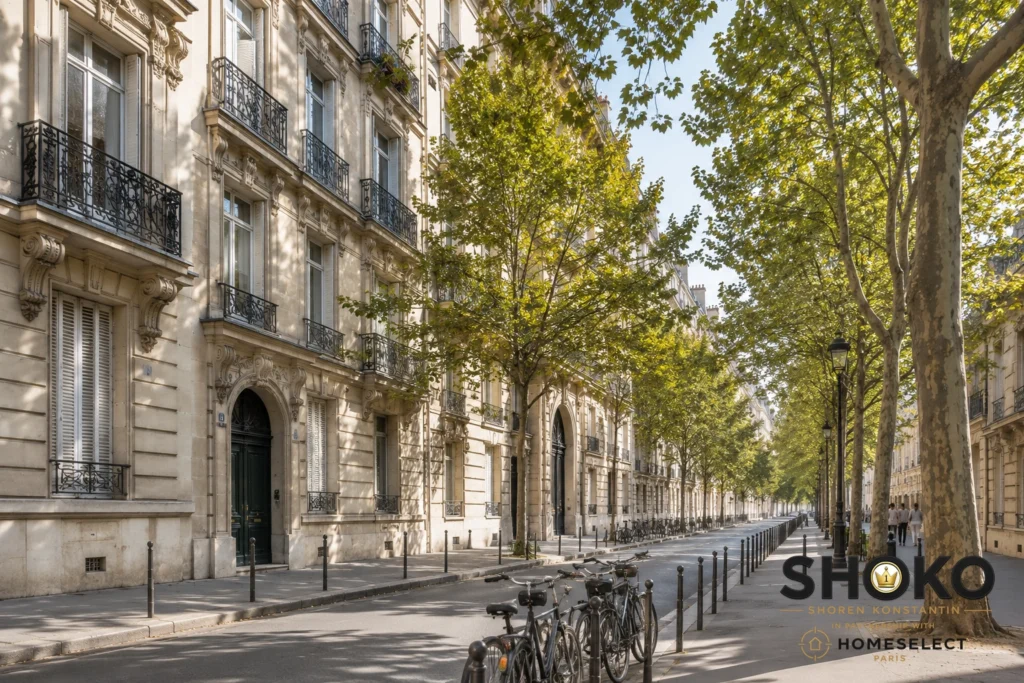
Scandinavian buyers active in Paris tend to cluster around a specific set of arrondissements. The 7th, with its wide pavements, residential calm, and proximity to cultural institutions, appeals to buyers who value quiet urban living without sacrificing central access. The 6th, particularly the streets south of Boulevard Saint-Germain, attracts those with design and cultural sensibilities who want to feel genuinely embedded in the intellectual and aesthetic life of the city. Parts of the 5th, around the Jardin des Plantes and the quieter streets of the Latin Quarter, draw buyers who want historic character combined with a neighbourhood that functions as a genuine community rather than a showcase address.
The 16th makes occasional appearances for family-oriented buyers seeking more space, proximity to international schools, and a residential environment that prioritises green space and quiet streets. However, the more design-conscious segment of the Scandinavian buyer population tends to find the 16th too conservative in character — a preference that reflects broader differences within the cohort itself.
What Scandinavian Buyers Look for in an Apartment
This buyer profile brings a specific aesthetic to the acquisition process. Scandinavian design culture places significant emphasis on light, proportion, and material quality — criteria that translate directly into preferences within the Parisian market. High ceilings and good natural light, particularly northern and western orientations that maximise diffused daylight rather than direct afternoon sun, tend to rank highly. Original architectural detail is valued, but so is the quality of any subsequent renovation — buyers from this cohort are often discerning about finishes in a way that not all international buyers are.
Courtyard-facing apartments, which certain other international buyer profiles view as less desirable than street-facing equivalents, often appeal to Scandinavian buyers precisely because of the light quality and acoustic calm they offer. This willingness to consider a broader range of apartment configurations within the same building — and to evaluate them on their intrinsic merits rather than their symbolic street presence — gives Scandinavian buyers a practical advantage in a market where the obvious choices attract the most competition.
The Investment Logic Running Beneath the Surface
For many Scandinavian buyers, the Paris acquisition is not purely a lifestyle decision. It sits within a broader wealth management framework in which geographic diversification of real estate holdings is an explicit goal. French property, governed by a clear legal system, notarially documented, and denominated in euros, provides a counterweight to Scandinavian residential holdings in a way that feels structurally meaningful — not just emotionally appealing.
The French tax treaty network, which covers all four Scandinavian countries, means that the double taxation concerns that complicate cross-border ownership in some jurisdictions are addressed by existing frameworks. This reduces the structural friction of ownership without eliminating the need for careful legal and tax advice at the point of acquisition — advice that experienced independent buyer representation can help identify and coordinate.
Why This Cohort Often Prefers a Guided Search Approach
Scandinavian buyers in Paris are typically thorough, patient, and resistant to pressure-based sales dynamics. They research before they visit, ask detailed questions about building condition and ownership structure, and tend to take longer than some other nationalities to reach a decision — not from indecisiveness, but from a methodical approach to significant financial commitments that is deeply culturally embedded.
This profile aligns naturally with a guided property search methodology rather than a rapid listing-based approach. Working through the market systematically, with someone who understands both the acquisition criteria of this buyer profile and the specific dynamics of Parisian residential supply, tends to produce better outcomes than navigating multiple agencies independently — each of whom has a structural incentive to push available stock rather than identified fit.
The Scandinavian buyers who find their ideal Paris apartment are almost invariably those who treated the search as a considered process rather than a reactive one.
If you are exploring Paris property from Scandinavia and want a structured approach to your search, Contact SHOKO to discuss how independent property discovery works in practice.
Recommended Reads
1. What Is a Notaire in France — Foreign Buyer Guide — buypropertyfrance.com
2. The Real Cost of Buying Property in France — buypropertyfrance.com
3. The French Property Buying Process Explained — buyeragentfrance.com
4. The Biggest Risks International Buyers Face When Purchasing Property in France — buyeragentfrance.com