
The Moment the Gap Becomes Real
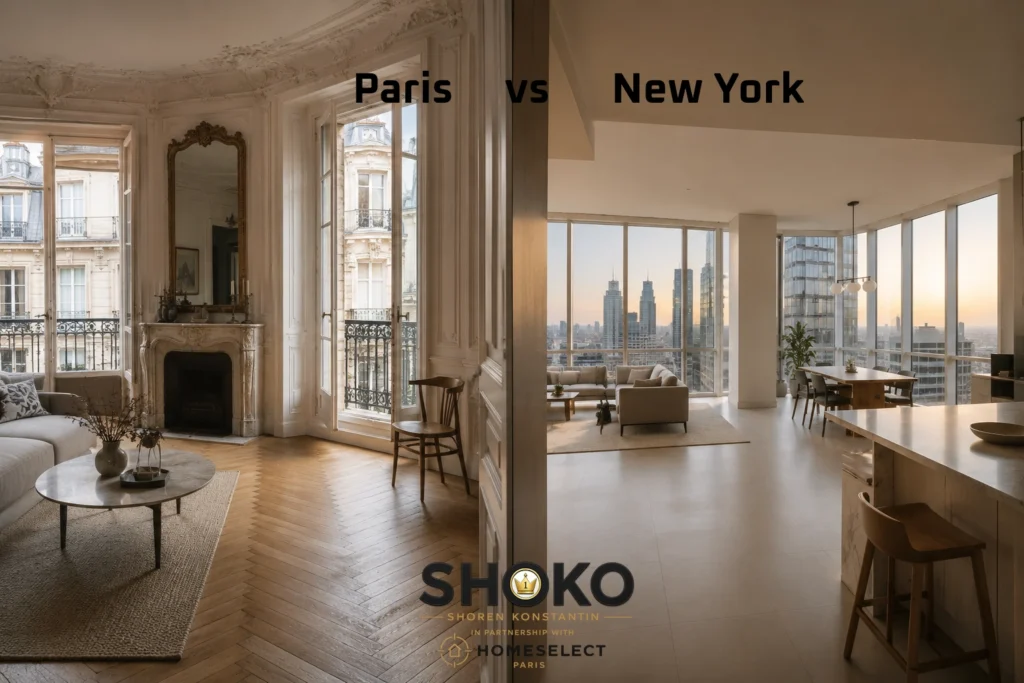
It usually happens within the first ten minutes of the first viewing. A North American buyer — whether from Toronto, Vancouver, New York, or Chicago — steps into a Paris apartment and experiences something they were not entirely prepared for. The space is different. Not just architecturally different, but different in a way that is harder to name. The logic of how the rooms relate to each other, how the light moves through the apartment, how the kitchen sits in relation to the living area — none of it follows the pattern they have absorbed over years of property searching at home.
This moment of disorientation is not a problem. It is the beginning of understanding a residential culture that rewards curiosity and penalises assumptions. Buyers who lean into it tend to find the Paris market genuinely thrilling. Buyers who resist it spend their search trying to find a North American condo that happens to be located in Paris — and that search rarely ends well.
The Open Plan Question
North American residential design has, over the past three decades, converged almost entirely on the open-plan model. The kitchen flows into the dining area. The dining area flows into the living room. The whole ground floor — or the primary living floor — is one connected space where visual and social connection is maximised. This is not just a stylistic preference. It has become, for most North American buyers, a baseline expectation of what a functional home looks like.
Paris apartments, particularly in Haussmann-era buildings that make up the most sought-after residential stock in the city, operate on a fundamentally different spatial philosophy. Rooms are defined and enclosed. The kitchen is typically separate from the reception rooms.
The living room and dining room may be distinct spaces, connected by doors rather than open archways. The salon — the principal reception room — faces the street. The kitchen and service areas face the courtyard.
This arrangement is not a historical accident. It reflects a conception of domestic life in which different activities belong to different spaces, and in which the home is organized around reception, privacy, and hierarchy of use rather than continuous visual openness. For buyers who understand this, the enclosed floor plan becomes legible — even appealing. For buyers who do not, it reads as inefficient or dated.
How Space Is Measured and What That Means
North American buyers are accustomed to thinking about property in terms of total square footage — a single number that represents the gross area of the home. That number is used to compare properties, calculate value per square foot, and form an initial sense of whether a property is worth visiting.
French property listings use the Carrez Law measurement, which excludes areas with ceiling heights below 1.80 metres, along with balconies, terraces, cellars, and parking. The result is a surface area figure that measures legally defined habitable space rather than gross area — and that figure can look modest compared to what North American buyers expect at similar price points.
The practical consequence is that a Paris apartment listed at 85 square metres will often feel considerably larger in person than a North American buyer expects from that number. The ceiling heights — typically 2.8 to 3.2 metres in Haussmann buildings — create a volume of space that square metre figures do not capture. The proportions of the rooms, the depth of the floor plan, and the relationship between interior and exterior light all contribute to a spatial experience that metrics alone cannot convey.
Buyers who arrive in Paris judging apartments by surface area numbers and then converting to square footage are consistently surprised — sometimes pleasantly, sometimes not — by what they actually find when they open the door.
The Condo Amenity Model and Its Absence
North American condominium buildings — particularly newer developments in cities like Toronto, Vancouver, Miami, or New York — have built a residential culture around shared amenities. Concierge services, fitness centres, rooftop terraces, indoor pools, co-working spaces, and private dining rooms are not exceptional features in a premium North American condo. They are standard components of the product.
Paris apartment buildings do not offer this model. The building amenities in a classic Parisian immeuble are typically minimal by North American standards: a gardien or building manager, a shared courtyard, perhaps a cave or cellar space, and an elevator in buildings where one has been retrofitted. The idea of a gym on the ground floor or a rooftop lounge available to all residents is essentially absent from the Parisian residential market.
For North American buyers, this absence requires a reorientation of what residential value looks like. In Paris, value sits inside the apartment itself — in the ceiling height, the floor quality, the orientation, the view, and the neighbourhood context — rather than in a menu of shared facilities. The city itself functions as the amenity. The café on the corner, the market three streets away, the park within walking distance — these are what Paris offers in place of a building fitness centre, and they are available to everyone, not just residents of a specific development.
Balconies, Terraces, and the Relationship With Outside
North American condos, particularly at mid to high price points, place significant value on private outdoor space. A large balcony or terrace is a major selling feature. Floor-to-ceiling glazing that maximises the visual connection between interior and exterior is considered a design achievement. Indoor-outdoor living — the ability to open the home entirely to outside air and light — is an aspiration built into the product.
Paris apartments have a different relationship with the exterior. Balconies exist in Haussmann buildings — the narrow Juliet balconies on the façade side are a signature feature — but they are rarely large enough to function as outdoor living spaces. True terraces are uncommon and, when present, command significant premiums. The relationship with the outside in a Parisian apartment is more often mediated through tall windows, views across rooftops, and the quality of natural light that enters a well-oriented apartment at different times of day.
Buyers who require substantial private outdoor space will find the Paris market limiting. Buyers who are willing to reframe their relationship with outside — to experience it through long windows and neighbourhood streets rather than a private terrace — will find that what Paris offers in return is considerable.
What Buyers Come to Understand
The cultural differences between Paris apartments and North American condos are real and consistent. They do not disappear with familiarity — they become better understood. Buyers who spend time in the Paris market, who visit enough properties to develop a feel for the spatial logic of different building types and periods, consistently report the same evolution in their perception.
What began as disorientation gradually becomes appreciation. The enclosed rooms start to feel like privacy rather than constraint. The separate kitchen becomes a feature of a certain kind of domestic life. The absence of building amenities stops feeling like a lack and starts feeling like a different set of priorities — ones that turn out to align quite naturally with why they wanted to live in Paris in the first place.
The gap between North American condo expectations and Parisian apartment reality is not a reason to hesitate. It is the first thing worth understanding before the search begins.
If you are beginning your Paris property search from a North American perspective and want to develop a clear picture of what the market actually offers, Contact SHOKO to discuss a guided property discovery consultation.
Recommended Reads
How Paris Apartments Compare to Manhattan Luxury Condos — gtamarket.ca
What American Buyers Misunderstand About Paris Apartment Sizes and Layouts — gtamarket.ca
Buying Property in France: A Complete Guide for International Buyers — buypropertyfrance.com
Living in Paris as an Expat: Choosing Between the 7th, 8th and 16th Arrondissements — homefrance.eu